
One codebase, two stores. When it fits.
Cross-platform halves the build and roughly halves ongoing maintenance, which is the bigger number. It's the wrong call when your app leans hard on platform-specific capability — and we'll say so rather than selling you the cheaper option.
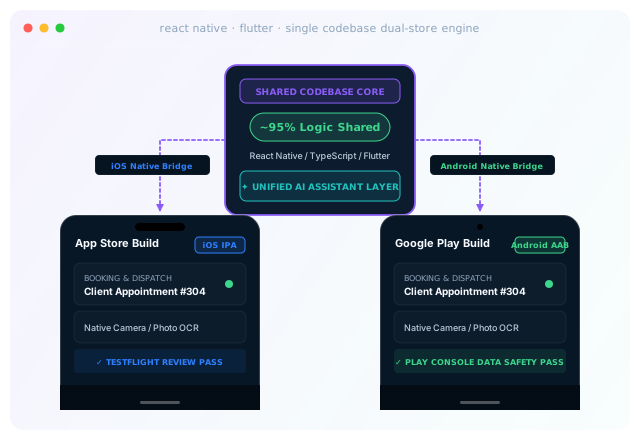
Built for teams maximizing dual-store velocity.
Businesses needing both stores on one budget
And whose app is mostly forms, lists, and business data rather than hardware-intensive device work.
Teams with an existing web codebase
React experience and TypeScript data schemas transfer directly to React Native without rewriting.
Anyone maintaining two apps drifting apart
Paying twice for every feature change, fixing bugs in two places, and suffering feature divergence.
CROSS-PLATFORM STACK & FRAMEWORKS
What we build in cross-platform.
Single-codebase architecture backed by native device bridge modules.
React Native Apps
Where your team already knows React, or where the app is data-and-forms rather than device-heavy.
- React and TypeScript
- Shared logic with your web app
- Native modules where needed
Flutter Apps
Where consistent interface behaviour across platforms matters more than platform-native feel.
- Dart and Flutter
- Pixel-consistent both platforms
- Strong animation performance
Native Modules Where Needed
Cross-platform doesn't mean giving up capability. Platform-specific code is written where the shared layer can't reach.
- Camera, biometrics, background work
- Written natively, exposed to shared code
- Only where genuinely required
Shared Business Logic
Validation, sync, and data rules written once, so behaviour can't drift between the two apps.
- Single source of truth
- Consistent behaviour both stores
- One place to fix a bug
Both Store Submissions
App Store and Play, with their different requirements, handled together in synchronized release cycles.
- Both review processes managed
- Both compliance regimes verified
- Coordinated releases
Native vs. cross-platform.
An honest comparison. Neither wins every time.
| Dimension | Native (per platform) | Cross-Platform (React Native / Flutter) |
|---|---|---|
| Initial build | Two builds, two timelines | One build |
| Ongoing maintenance | Two codebases | One codebase |
| Platform feel | Best possible | Very good, occasionally noticeable |
| Deep device capability | Full, direct | Available via native modules |
| Heavy animation or graphics | Better | Adequate to good |
| Best when | Device capability or feel is the product | The app is data, forms, and workflow |
That final row is the decision. Most business apps are the right-hand column.
How implementation works.
From platform fitness audit to dual-store release and coordinated maintenance.
1. Consult
Free. The real question is whether cross-platform fits, and we answer that before anything else.
2. Scope
Fixed price, screen inventory, framework choice, native module list.
3. Build
8 to 14 weeks for both platforms, testable on both from the halfway point.
4. Submit
Both stores, coordinated.
5. Maintain
One codebase, but two sets of OS updates and store policies. Covered under care plans →.
Reference build. A standard implementation pattern for this problem, not a client project. It describes how CloudArk builds this kind of application and what delivery involves.
Dual-Store Consolidation & Unified React Native Core
Two separately built apps that had drifted apart: features present on iOS were missing on Android, and every change was quoted and built twice.
Single React Native rebuild with shared business logic, native modules for camera and push, and coordinated releases to both stores.
Figures are modelled to illustrate the shape of the change, not measured client results.
AI built into cross-platform.
Unified AI layer delivering uniform assistant and extraction intelligence across platforms.
Shared AI layer
Document capture, extraction, and assistant features written once and running identically on both platforms.
- Identical extraction parsing both stores
- Shared TypeScript schema validation
- Single maintenance surface for AI logic
Consistent grounding
Both apps answer from the same knowledge source, so guidance can't differ by platform. See custom AI systems →.
- Unified embedding cache
- Zero cross-platform citation drift
- Identical security & privacy boundary
Frequently asked questions.
Book a free 30-minute cross-platform consult.
We'll compare React Native and Flutter for your application, identify any required native modules, and scope your timeline.
- Practical architecture conversation with an engineer, not a sales deck.
- Objective comparison between React Native and Flutter for your stack.
- You keep the review findings whether we work together or not.
Thanks for reaching out.
A CloudArk solutions engineer will review your inquiry and email you within one business day with scheduling availability.